Mini
Titrator For Measuring Titratable Acidity In Dairy Products
The
HI-84529-02 is an easy to use, fast and affordable automatic mini titrator
designed for testing titratable acidity levels in dairy products. Based on
an acid-base titration method, this mini titrator uses an optimized
pre-programmed method of analysis with a powerful algorithm that
determines the completion of the titration reaction by the use of a
specialized foodcare pH electrode.
The
HI-84529-02 incorporates a precision piston style dosing pump that adjusts
the volume of dosing dynamically based on the voltage change. This dosing
system reduces the amount of time required for the titration while
providing for a highly accurate determination of the amount of titrant
used.
This
mini titrator is supplied complete with all the materials necessary to
perform low and high range measurements of titratable acidity. All
chemicals are premixed and prepackaged including standardized titrants,
reagents and pump calibration solution. There is no need for volumetric
glassware or analytical balances.
- Piston
driven pump for accurate dynamic dosing
- Complete
with anti-clogging reference electrode
- Pre-standardized
titrant and pre-measured reagents
The
HI84529 uses methods based on AOAC International and Standard Methods for
the Examination of Dairy Products. Both of these methods report titratable
acidity as % lactic acid and a conversion factor is used to convert the
results to the other available units. The HI84529 can be customized to
meet the needs of any dairy analysis lab. Samples can be titrated by
weight or volume, diluted or non-diluted (low range only) and titrated to
a fixed pH endpoint that can be adjusted by the user. The HI84529 offers
three different methods depending on the expected range and the weight of
sample used. Select low range 50 to titrate a 50 mL or 50 g undiluted
sample. The other titration options are low range 20 and high range 20 to
titrate 20 mL or 20 g samples that are diluted twice their volume with
deionized or distilled water.
There
are two fundamentally different measurements of dairy products: titratable
acidity and pH. pH is a measurement of hydrogen ion concentration while
titratable acidity is the neutralizing capacity of a dairy product with
NaOH. An increase in acidity can be caused by bacteria formation.
Monitoring acidity is a way of determining the quality and freshness of
dairy products. Acidity is determined by a pH endpoint titration using
NaOH (sodium hydroxide), and is defined as the consumption necessary to
shift the pH value from 6.6 (corresponding to fresh milk) to a
pre-determined pH value. When using phenolphthalein as an indicator, a
faint pink color change occurs at pH 8.3.
Titratable
acidity is expressed in a variety of units based on the titration method
performed. Each method varies in sample size and strength of NaOH used for
the titration.
%
Lactic Acid (%l.a.): Determined by taking a 20 mL or 20 g
sample and diluting with twice its volume with deionized or distilled
water. The sample is then titrated with 0.1 M NaOH to a phenolphthalein
endpoint.
Degree
Soxhlet Henkel (°SH): Determined by titrating a 50 mL sample
with 0.1 M NaOH to a phenolphthalein endpoint.
Degree
Dornic (°D): Determined by titrating a 100 mL sample with N/9
NaOH to a phenolphthalein endpoint.
Degree
Thörner: Determined by taking a 10 mL sample and diluting with
twice its volume with deionized or distilled water. The sample is then
titrated with 0.1 M NaOH to a phenolphthalein endpoint.
Knowing
the relationship between sample weight or volume and strength of titrant
it is possible to convert the reading obtained from one method to another.
Below is a table with the factors preprogrammed in the HI84529 for
converting between various units of measure.
| From: |
To: |
Divide
By: |
| %l.a. |
°SH |
0.0225 |
| %l.a. |
°D |
0.0100 |
| %l.a. |
°Th |
0.0090 |
Table
for converting % lactic acid (%l.a.) to Degree Soxhlet Henkel (°SH),
Degree Dornic (°D), and Degree Thorner °Th.
Application-Specific
Half-Cell pH Electrode
The
HI84529 is supplied with the FC260B half-cell glass body pH electrode. A
pH half-cell electrode consist only of the pH indicating electrode. There
is no reference cell with a junction. The FC260B half-cell electrode uses
low temperature (LT) glass with a spherical bulb and glass body. This
design consideration is ideal for direct pH measurement or titration of
dairy related products.
Low
Temperature Glass Formulation
The
glass tip uses a special LT glass formulation with a lower resistance of
approximately 50 megaohms compared to general purpose (GP) with a
resistance of about 100 megaohms. This is beneficial since many dairy
products are stored at low temperatures. As the temperature of the glass
decreases in the sample, the resistance of the LT glass will increase
approaching that of GP glass at ambient temperatures. If using GP glass,
the resistance would increase above the optimum resistance for the high
impedance input of a pH meter. The FC260B is suitable to use with
samples that measure from -5 to 100℃.
Reference
Half-Cell
Most
pH electrodes are combination pH electrodes in which both half cells are
supplied in a single probe design. The reference cell of these
electrodes typically have a junction made of ceramic, glass, or PTFE.
The junction of a reference electrode provides the electrical pathway
between the inner portion of the electrode and the sample The HI84529 is
supplied with the HI5315 reference half-cell. The HI5315 has a skirted
cone junction that allows for an extremely stable reference voltage with
the sample. The HI5315 features a plunger design that can be used to
flush any solids that have accumulated at the junction surface. The
HI5315 can also be completely disassembled for cleaning. The ability to
maintain a clean open junction allows for repeatable and accurate
measurement.
Piston
Driven Dosing Pump
The heart of the HI84529 is the
piston driven burette pump. This type of dosing system uses a motor in
which each dose is very precisely controlled and the volume dispensed is
accurately determined. The piston driven burette is controlled
dynamically so that the volume of titrant being dosed is automatically
adjusted based on a voltage response of the previous dose. This type of
dosing speeds up the titration process by allowing for more titrant to
be dosed at the start of the titration and then very small doses as the
endpoint is reached.
Custom
pH Calibration
According
to AOAC International and Standard Methods for the Examination of Dairy
Products the titration endpoint for % lactic acid is pH 8.3. The HI84529
uses custom calibration points based on the pH of fresh milk and the
titration endpoint. The preprogrammed pH 6.00 and pH 8.30 calibration
points allows for calibration of the meter that brackets the pH
readings.
Good
Laboratory Practice
The
HI84529 offers comprehensive GLP information including date and time of
the last pH electrode and dosing pump calibrations. Tracking
calibrations are critical to have confidence in the results obtained
from titrations. The GLP data is stored along with any logged readings.
Automatic
Stirrer
The
built-in stirrer is automatically maintained at a speed of 800 rpm for
low range titrations and 1000 rpm for high range titrations, regardless
of the viscosity of the solution being titrated.
On-Screen
Features
Easy-to-Use
InterfaceThe HI84529 has an intuitive user design with
clearly defined keys and a large screen that is easy to navigate. The
meter has a built-in tutorial mode that, when enabled, will walk the
user step by step through the titration process. A dedicated HELP key
is always available to allow access to content-specific information
during both calibration and titration.
Procedure
Warnings Users are warned if there is an
error in procedures such as the titration exceeded the maximum volume
of titrant.
Graphic
Mode This mini titrator displays in-depth
data during titration, including a real-time graph of the titration
curve.
Log-on-DemandThe
HI84529 allows for data logging of up to 400 samples: 200 titration
results and 200 pH/mV readings. Data can be stored and exported to a
USB drive or a PC using the USB connection.
pH/mV
MeterIn addition to being an automatic titrator, the HI84529
also can be used as a pH/mV meter. As a pH meter, it has many features
of a professional grade benchtop including automatic calibration up to
three points with four available buffers, a 0.01 pH resolution, accuracy
of ±0.01 pH, automatic temperature compensation and comprehensive GLP
data.
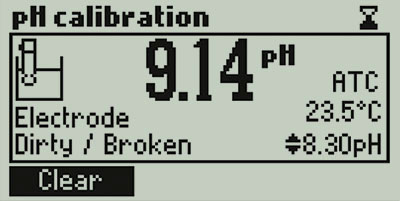
CAL
Check™ Accuracy
is always ensured with Hanna’s unique CAL Check feature, which analyzes
the response of the electrode during the calibration process. Based on
electrode response in the buffer, indicators are displayed on screen to
alert the user of potential problems during calibration. These indicators
include Buffer Contaminated, Electrode Dirty/Broken, and overall probe
condition. The CAL Check function not only ensures an accurate pH reading
when the HI84529 is used as a pH meter, but also an accurate titration
since the endpoint of a titratible acidity titration is determined by a
set pH value.
| pH-mV
Range |
-2000.0
to 2000.0 mV |
| pH-mV
Resolution |
0.1
mV |
| pH-mV
Accuracy |
±1.0
mV |
| pH
Range |
-2.0
to 16.0 pH; -2.00 to 16.00 pH |
| pH
Resolution |
0.1
pH / 0.01 pH |
| pH
Accuracy |
±0.01
pH (@25ºC/77ºF) |
| pH
Calibration |
one,
two or three-point calibration; four available buffers (4.01, 6.00,
8.30, 10.01) |
| pH
Temperature Compensation |
manual
or automatic |
| Temperature
Range |
-20.0
to 120.0°C; -4.0 to 248.0°F; 253.2 to 393.2 K |
| Temperature
Resolution |
0.1°C;
0.1°F; 0.1K |
| Temperature
Accuracy |
±0.4°C;
±0.8°F; ±0.4 K (@25ºC/77ºF), without probe error |
| Titration
Method |
acid
base titration |
| Titration
Principle |
endpoint
titration, adjustable (pH 8.0 – 8.7 in 0.1 increments) |
| Titration
Range |
Low
Range: %l.a.: 0.01 to 0.20; °SH: 0.4 to 8.9; °D: 1.0 to 20.0; °Th:
1.1 to 22.2
High Range: %l.a.: 0.1 to 2.0; °SH: 4.4 to 88.9; °D: 10 to 200; °Th:
11.1 to 222.2 |
| Titration
Resolution |
Low
Range: %I.a.: 0.01 ; °SH: 0.1; °D: 0.1; °Th: 0.1 High Range: %I.a.:
0.1; °SH: 0.1; °D: 1; °Th: 0.1 |
| Titration
Accuracy |
Low
Range: ± 0.01 %l.a. High Range: ± 0.1 %l.a. (@25ºC/77ºF) |
| Sample
Size |
LR
20: 20 mL or 20 g LR 50: 50 mL or 50 g HR 20: 20 mL or 20 g |
| Titration
Pump Speed |
10
mL/min |
| pH
Electrode |
FC260B
pH electrode with 1 m (3.3’) cable (included), HI5315 reference
electrode with 1 m (3.3’) cable (included) |
| Temperature
Probe |
HI7662-M
temperature probe with 1 m (3.3’) cable (included) |
| Logging
Type |
Log-on-demand |
| Logging
Memory |
up
to 400 ( 200 titrations, 200 pH/mV readings) |
| Connectivity |
1
USB port for data storage and export to a PC |
| Built-in
Magentic Stirrer |
Built-in
magnetic stirrer at 800 rpm (Low Range) / 1000 rpm (High Range) |
| Power
Supply |
12
VDC adapter (included) |
| Environment |
0
to 50°C (32 to 122°F); RH max 95% non-condensing |
| Dimensions |
235
x 200 x 150 mm (9.2 x 7.9 x 5.9”) |
| Weight |
|

