Direct
Soil Measurement pH Portable Meter
The
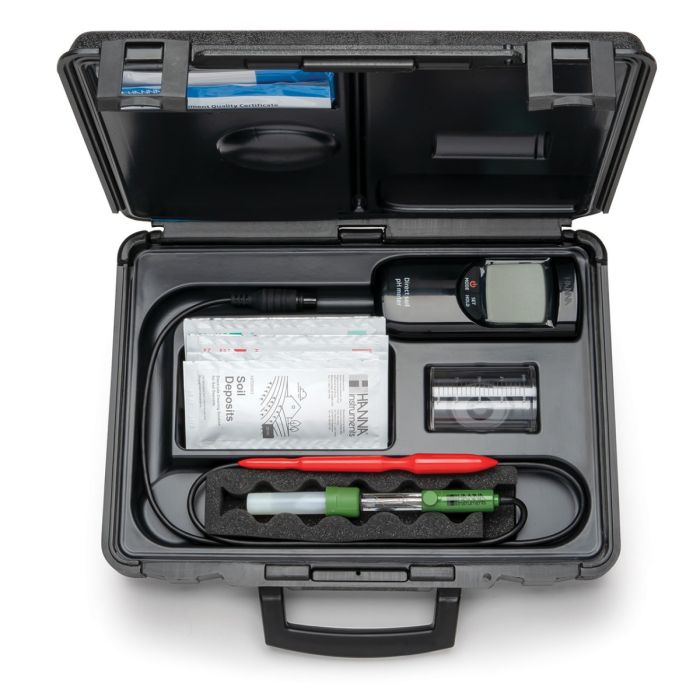
HI-99121 is the perfect portable pH meter for soil testing. With the
HI-99121 and HI-12923 direct soil pre-amplified pH and temperature
probe, users can test both the pH of soil directly or after preparation
of a soil slurry with deionized water.
The
HI-12923 features a conical, rugged tip that can be directly inserted
into moist or soft soil. For harder soils, the kit includes a plastic
auger to perforate the ground.
- Automatic
Temperature Compensation
- Automatic
Two-Point Calibration
- Waterproof
Soil
can be acid, neutral or alkaline, according to its pH value. Most plants
prefer a pH range from 5.5 to 7.5; but some species prefer more acid or
alkaline soils. Nevertheless, every plant requires a particular range of
pH, for optimum growth.
Each
plant needs elements in different quantities and this is the reason why
each plant requires a particular range of pH to optimize its growth. For
example, iron, copper and manganese are not soluble in an alkaline
environment. This means that plants needing these elements should
theoretically be in an acidic type of soil. Nitrogen, phosphorus,
potassium and sulfur, on the other hand, are readily available in a pH
range close to neutrality. Furthermore, abnormal pH values, increase the
concentration of toxic elements for plants. For example, in acid
conditions, there can be an excess of aluminum ions in such quantities
that the plant cannot tolerate.

Refillable
Turn
cap to create positive head pressure allowing for more reference
electrolyte to flow.

Built-In
Temperature Sensor
Automatic
compensation of temperature variations.
Amplified
Electrode
Fast,
stable response that is immune to electrical noise due to humidity.
Soil
can be acid, neutral or alkaline, according to its pH value. Most plants
prefer a pH range from 5.5 to 7.5; but some species prefer more acid or
alkaline soils. Nevertheless, every plant requires a particular range of
pH, for optimum growth.
pH strongly influences the availability of nutrients and the presence of
microorganisms and plants in the soil. For example, fungi prefer acidic
conditions whereas most bacteria, especially those supplying nutrients
to the plants, have a preference for moderately acidic or slightly
alkaline soils. In fact, in strongly acidic conditions, nitrogen fixing
and the mineralization of vegetable residual is reduced. Plants absorb
the nutrients dissolved in the soil water and the nutrient solubility
depends largely on the pH value. Hence, the availability of
elements is different at different pH levels.
Each plant needs elements in different quantities and this is the reason
why each plant requires a particular range of pH to optimize its growth.
For example, iron, copper and manganese are not soluble in an alkaline
environment. This means that plants needing these elements should
theoretically be in an acidic type of soil. Nitrogen, phosphorus,
potassium and sulfur, on the other hand, are readily available in a pH
range close to neutrality. Furthermore, abnormal pH values, increase the
concentration of toxic elements for plants. For example, in acid
conditions, there can be an excess of aluminum ions in such quantities
that the plant cannot tolerate. Negative effects on chemical and
physical structure are also present when pH values are too far from
neutral conditions (break up of aggregates, a less permeable and more
compact soil).
The HI-99121 meter features a large multi level LCD screen which
displays both pH and temperature readings simultaneously with 0.01 pH
resolution and an accuracy of ±0.02 pH. The LCD screen also has
indicators for calibration status and stability, as well as on-screen
tutorial messages. The HI99121 has many advanced features that are found
in more expensive portable instrumentation including automatic
calibration, buffer recognition,and temperature compensation. The
battery percent level is displayed at start up alerting the user to the
remaining battery power that is available. The supplied HI-12923 is a
glass body, amplified pH electrode with a built-in temperature sensor
designed specifically for measuring the pH in soils.
Features
at-a-glance
- Automatic
Temperature Compensation
- One
or two-point automatic calibration
- BEPS
- Alerts the user of low battery power that could adversely affect
readings
- Compact,
heavy-duty, and waterproof
- Battery
% displayed on start-up
- HELP
feature, displays messages on LCD
Features
- Automatic
Temperature Compensation
- One
or two-point automatic calibration
- BEPS
- Alerts the user of low battery power that could adversely affect
readings
- Compact,
heavy-duty, and waterproof
- Battery
% displayed on start-up
- HELP
feature, displays messages on LCD
Specifications
| pH
Range |
-2.00
to 16.00 pH; -2.0 to 16.0 pH |
| pH
Resolution |
0.01
pH; 0.1 pH |
| pH
Accuracy |
±0.02
pH; ±0.1 pH |
| pH
Calibration |
automatic,
at one or two points with two sets of standard buffers (pH 4.01 /
7.01 / 10.01 or pH 4.01 / 6.86 / 9.18) |
| pH
Temperature Compensation |
automatic
‐5.0 to 105.0 °C/23.0 to 221.0 °F |
| pH
CAL Check (electrode diagnostics) |
probe
condition indicator |
| mV
Range |
±825
mV (pH‐mV) |
| mV
Resolution |
1
mV |
| mV
Accuracy |
±1
mV (pH‐mV) |
| Temperature
Range |
-5.0
to 105.0°C / 23.0 to 221.0°F |
| Temperature
Resolution |
0.1°C
/ 0.1°F |
| Temperature
Accuracy |
±0.5°C
(up to 60°C); ±1.0°C (outside) / ±1°F (up to 140°F); ±2.0°F
(outside) |
| pH
Electrode |
HI12923
glass body, pre-amplified pH electrode for soil measurement with
internal temperature sensor, quick connect DIN connector and 1 m
(3.3’) cable (included) |
| Automatic
Shut-Off |
user
selectable |
| Battery
Type/Life |
1.5V
(3) AAA / approximately 1400 hours of continuous use; auto-off
after 8 minutes of non-use |
| IP
Protection |
IP67 |
| Environment |
0
to 50°C (32 to 122°F); RH max 100% |
| Dimensions |
154
x 63 x 30 mm (6.1 x 2.5 x 1.2”) |
| Weight |
196
g (6.91 oz.) |
Product Manual

Brand : Hanna Instruments